|
UNPO MONITOR
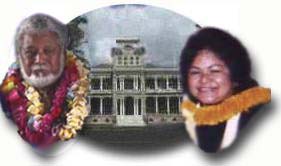
(This is the partial text of a meeting
in which current Kingdom of Hawaii was represented. Majesty
Akahi Nui has since been recognized as the official
representative for the Hawaiian People and so directs who is
their representative to this organization. At this
particular occasion Hawaii was represented by His
wife.)
Unrepresented Nations and Peoples Organization
UNPO 1997
Draft Summary of the Principal Points
Raised at the
United Nations Working Group on Indigenous
Populations
This Monitor is a draft. The final
corrected and edited version will also be available at
<http://www.unpo.org> or can be ordered at the UNPO Office in the
Hague, the Netherlands. UNPO apologizes for any
inaccuracies.
Day 2, Tuesday July 29, 1997 Working
Group, Morning Session
1.Ms. Erica-Irene Daes, Chairperson:
Wishes everyone a good
morning and declares the meeting open. Reports on the
results of the private
meeting of the members of the Working Group yesterday
afternoon and
notes it was decided not to change the order of the items of
the agenda.
Notes, however, that in organizing the work of the session,
attention will be
paid to assure that a full discussion is held under each
item, including in
particular, the item on a permanent forum for indigenous
peoples. States that
in view of the large number of participants, the Working
Group decided that
the list of speakers will be open on all items of the agenda
and it will be
closed at 6:30 p.m. this afternoon. Says that speakers
should provide their
names, the title of their organization and the country from
which they come.
Says that this will allow the Secretariat to divide the time
more favourably
and effectively. Notes that she will give the floor to the
Secretariat for some
information on documentation for the session.
2.Mr. Julian Burger, Secretary, Working
Group on Indigenous
Populations: Thanks the Chairperson. States that he has
information
regarding documents on the Working Group. Mentions that the
agenda is
available at the door . States that the annotated version of
document
E7N4/2/AC4/1997/2 is available in the 6 official languages.
Adds that the
supplementary working paper of the Special Rapporteur is
also available at
door 40. States that document 3 is not available. Clarifies
that it was to be a
document by the Secretariat on land and environment but was
found to be
unnecessary. Adds that the document on health and indigenous
peoples is
also not available at this time. Continues that document
ECN4/AC 4/1997 /5
is information on the Voluntary Fund and is available in all
the official
languages. States that the draft on the Permanent Forum has
been submitted.
Mentions that the working paper by the Special Rapporteur on
land rights is
unavailable at this time.
3.Ms. Erica-Irene Daes, Chairperson:
Thanks the Secretariat for the
information concerning the documents. Appeals to all
participants to be as
brief as possible although there is no limitation of time
for the speeches.
Reminds everyone that they must respect the right of others
to speak. Notes
that those that have attended meetings in the past years
know that she likes to
preserve the order in the room. Reminds that no one should
talk privately in
the conference room but do so outside if need be. Hopes that
the time will be
used efficiently. Introduces agenda item no. 4 relating to
the standard
concerning the rights of indigenous peoples. Refers to the
working paper
she wrote on the concept of indigenous peoples. Notes that
she has not
changed her view since last year. Refers to the
comprehensive paper she
prepared at the 14th session, reference ECN4/
Sub2/AC/4/1996. Reaffirms
that no single definition can capture the vast diversity of
indigenous peoples.
States that it is therefore not desirable to arrive at
universal definition at the
present time. Recalls the meeting of the Working Group
during which the
members refused to define the concept. Recalls that this was
agreed to by the
government representatives. Notes, however, that certain
representatives
still have comments to make on the issue, therefore, the
matter will be
discussed further. Notes that she was requested to write a
supplementary
paper for this Working Group. States that all governments
will have the
occasion to express their opinion. Mentions that she had
asked for
a information from the governments and NGOs on this and has
received
nothing as yet. Gives floor to first speaker
A number of other speakers spoke first, but for
brevity I only include HH Wahine Akahi Nui's address to the
organization. The complete text is available from the
UNPO.
***25. Ms. Akahi
Nui, Kingdom of the Hawai'i Nation:
States that the Na
Kanaka Maoli indigenous people are the original inhabitants
of the island and their traditions and origins go back to
the life forces of nature itself.
Says that the origins
of the Na Kanaka Maoli people come from the earth, streams,
springs, crops, oceans, currents, winds, volcanoes and
various elements of nature. Continues by saying that these
people are part of nature and nature is part of them, and
their language has words for the love and the care of the
land.
Says that this is the
core of their philosophy since the people sustained their
relationship with land and extended family. Notes that the
indigenous peoples need access to the resources of the land
for substance which has always been the basis of their
existence.
Says that the Na
Kanaka Maoli peoples are seen as a poverty stricken people
with a high imprisonment rate. Thanks the
Chairperson.***[abbreviated by the UNPO
for space, to see entire speech see the 18
pages]
28.Mr. Miguel Alfonso Martinez, Member of the Working
Group:
States that the list of speakers has been exhausted. Adds
that in reference to
some of the issues on item four, the opinion of the experts
is that it is not
necessary to define indigenous peoples at this time. States
that not having a
definition could be misinterpreted as procrastination.
Emphasizes that it is
possible to have a declaration on indigenous peoples without
having a prior
definition on minorities. Reiterates that it is up to them
to define the concept of
indigenous peoples depending on the situation in which they
live. States that the
term indigenous peoples is plural. Adds that this is a
matter of customs and
history. Notes that the usage of "s" in indigenous peoples
in Spanish and
English was discussed. Adds that for many years, the UN has
struggled
between the difference between minorities and indigenous
peoples. States that
head way is being made in the Working Group. States that
there is little left to
discuss regarding item 4. Suggests that there should be a
focus on how to
improve the draft declaration at the government level.
Reminds that indigenous
peoples should not be confused with minorities. Adds that
the UN has an
appropriate format for minority issues. Underlines that
there is no need to
duplicating that.
29.Mr. El-Hadji Guisse, Member of the
Working Group: Says he wants
to share aloud his thoughts on the concept of indigenous
peoples. Notes that
some have called for a definition of indigenous peoples, and
says that while a
definition is not possible at the present stage of the
discussions, that did not
mean it is not useful. States that though impossible, it is
useful and this impels
the Working Group to discuss it and share views. Says that
when governments
call for a discussion, the point is not to reach a
definition of indigenous peoples
in the classical sense, but rather that a legal and social
framework should be
reached to use as reference and to harmonize action and
protect the rights of
indigenous peoples. Notes that this framework has to be
based on an
exhaustive review of criteria to say who is an indigenous
person and who is
not. Notes that this has already been used in the United
Nations system with the
concept of minorities. Says that it is desirable to move
toward a framework as
reference, and possibly to reach a definition accepted by
everyone. Notes that
within the United Nations, the concept of people or peoples
had different
meanings depending on the time and place about which one is
talking. Agrees
with the comments offered by the Swiss delegation as one
way, if not the only
way, to proceed, and endorses it. Notes that the
construction of international
law related to indigenous people is to protect them, and
requires scrupulous
respect for human rights, in general, and human rights of
indigenous peoples,
in particular. Notes that self-determination,
self-management, and autonomy are
all concepts used today. Says that self-determination is
used widely for people
under the colonial yoke, and in the struggle of the
Palestinian people. Hopes the
Working Group is careful in using this definition in
defending indigenous
peoples. Says that all these concepts require careful and
constructive reflection
and discussion by governments and indigenous people and
non-governmental
organizations and others. States that the procedure started
by the ILO
Convention 169 is just the start of a common effort to reach
something positive
for indigenous peoples. Thinks that the Working Group should
engage in a
general discussion, and should not be too hasty, even if too
much time has
already passed. Stresses the need for a useful and positive
instrument for the
search for a definition or legal framework to identify
indigenous peoples and to
protect their rights. Asks everyone to think about ways of
contributing to the
protection of indigenous peoples.
30.Mr. Ribot Hatano, Member of the
Working Group: Notes that
following the statements made this morning, he has an idea
of what the general
sentiment is concerning the definition of indigenous
peoples. Agrees with Ms.
Daes' conclusions in her working paper that it is neither
feasible nor desirable
to have a definition. Notes, however, that it may be
necessary to constitute a
definition of the concept in the future, after the adoption
of the Draft Declaration
by the General Assembly. Hopes that the Declaration could be
followed by a
treaty, binding all the parties, in which a piecemeal
definition could be
established.
31.Ms. Erica-Irene Daes, Chairperson:
Thanks Mr. Hatano for his
comments. Notes that he is the last speaker on the list.
Thanks everyone for
contributions. States that consideration of item 5 will
begin this afternoon at
3:00 pm. Requests that all be on time that statements are
kept brief and related
to recent developments. Adjourns the meeting.
This Monitor is not an official
transcript of the Working Group, but represents
substantially what was communicated during the meetings.
UNPO apologizes for any
inaccuracies. If you have corrections please contact the
UNPO Secretariat in Room
E3064
The Monitor is available on internet:
http://www.unpo.org/
UNPO Office of the General Secretary
Javastraat 40A
2585 AP The Hague
The Netherlands
2508 CN The Hague
Tel: +31-70-360 3318
Fax: +31-70-360 3346
EMAIL:unponl@unpo.org
Americas Coordination Office
444 North Capitol Street
Suite 846
Washington DC 20001
USA
Tel: +1-202-637 0475
Fax: +1-202-637 0585
Tartu Coordination
Tiigistr. 78-117
Estonia
Tel/Fax:+372-74-30805
|